Volume
9 – 28 September 2014 Sanderson Contemporary, Auckland
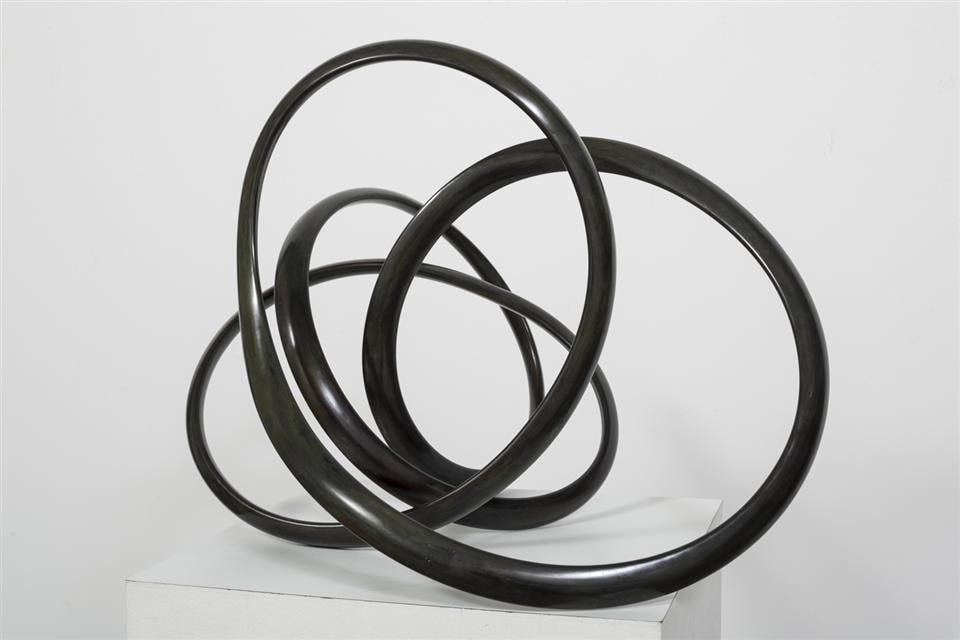
Volume introduced Ray Haydon’s carbon fibre Volume Series, shown with Möbius-like copper Flux works and hand-shaped mahogany reliefs. It came at a time when he was working extensively with kinetic sculpture: works that answer the wind in endlessly shifting formations.
Sculpture is in constant conversation with its environment. Ray isn’t replicating nature — he’s after pared-back forms that hold the essence of nature and movement. The kinetic works take that furthest: rather than looking at a static object, the viewer watches a work organically animated. Laura Howard’s essay for the show pointed to his monumental carbon fibre pieces Vesper and Vela, first shown in C6 (2012). Multiple pivot points let Vela split into separately moving sections, like a giant sail swinging its shadow over the viewer — it’s named for the southern constellation, the sails — while Vesper arcs towards the heavens. Their simplicity of line owes something to Brâncuși.
The curling copper works of the Flux series and some of the mahogany wall works take the form of Möbius strips — one continuous boundary, the eye swirling up and around a path that never ends. The hand-shaped mahogany reliefs read more like ancient architectural friezes, made to be seen from the front.
The freedom of the forms rests on precision underneath: three-dimensional mapping and maquettes for the big kinetic pieces, drawing on Ray’s industrial design background, and fabrication methods borrowed from boat building, jewellery and furniture making. Carbon fibre earned its place in the kinetic work for its strength-to-weight ratio — light enough to shift unpredictably with the wind, strong enough to be trusted doing it. Through these sculptures, as Howard put it, line comes to life.
Adapted from Laura Howard’s essay for Sanderson, 2014.
 View Artworks